
Catalog Advanced Search
-
Contains 5 Product(s)
Professional Development 5 Textbooks (digital)
A comprehensive textbook series from AHRA offering information on the latest, most effective best practices in imaging management.
- Asset Management in Radiology (3rd Edition)
- Communication & Information in Radiology (3rd Edition)
- Financial Management in Radiology (3rd Edition)
- Human Resource Management in Radiology (3rd Edition)
- Operations Management in Radiology (2nd Edition)
(purchased digital versions)
Bulk purchase discounts available! If the discount is not automatically triggered in your shopping cart, please reach out to [email protected].
- 5+ bundle purchase - 10% discount
- 10+ bundle purchase - 15% discount
All sales of ebooks are FINAL. No refunds or returns accepted on digital products.
-
Register
- Non-member - $420
- Member - $300
- More Information
-
Contains 29 Component(s), Includes Credits
This book addresses a wide variety of issues associated with the practice of human resource management including planning, recruitment, training, and retention. Changing demographics and employment patterns will demand that medical imaging administrators develop skills and expertise along with confidence in their ability to manage an ever changing constant in the workplace—human interaction. This book addresses the needs of administrators and managers regardless of the setting.
Human Resource Management in Imaging Management (3rd Edition)
All sales of ebooks are FINAL. No refunds or returns accepted on digital products.
-
Register
- Non-member - $99
- Member - $75
- More Information
-
Register
-
Contains 29 Component(s), Includes Credits
A wide variety of issues are discussed in this book including protocols, policies, and procedures; customer management and satisfaction; performance improvement tools; and marketing services. Effective operations management is critical to the success and well-being of a healthcare facility. Managing these processes and their associated workflows with expertise will help the imaging administrator better manage a thriving business.
Operations Management in Imaging Management (2nd Edition)
All sales of ebooks are FINAL. No refunds or returns accepted on digital products.
-
Register
- Non-member - $99
- Member - $75
- More Information
-
Register
-
Contains 3 Component(s), Includes Credits
AHRA April 2026 Quick Credit - The credit earned from the Quick Credit (TM) test accompanying this article may be applied to the AHRA Operations Management (OM) domain.
By Sharla Lester | April 8, 2026
Fluoroscopic examinations have declined over the last several decades. This review investigates the benefits and limitations of fluoroscopy and the procedures and modalities that have led to their decline. The literature suggests multiple limitations with fluoroscopy were identified, with few benefits. Furthermore, this review discusses fluoroscopic procedures in conjunction with other modalities, and what led to the decline in fluoroscopy examinations.
-
Register
- Non-member - $20
- Member - Free!
- More Information
-
Register
-
Contains 3 Component(s), Includes Credits
AHRA May/June 2026 Quick Credit - The credit earned from the Quick Credit (TM) test accompanying this article may be applied to the AHRA Operations Management (OM) domain.
By Sara J. Riskey, CRA | May 5, 2026
This report details the implementation of ProAqCT Radiation Dose and Image Quality Optimization Software at a 14-bed Critical Access Hospital. The project reduced CT radiation exposure, improved image quality, and ensured CMS compliance. Key strategies included system integration, technologist training, and quarterly QA/QC reviews. Early outcomes demonstrate measurable dose reduction, optimized protocol, and actionable insights supporting patient safety and regulatory adherence.
-
Register
- Non-member - $20
- Member - Free!
- More Information
-
Register
-
Contains 3 Component(s), Includes Credits
AHRA March/April 2026 Quick Credit - The credit earned from the Quick Credit (TM) test accompanying this article may be applied to the AHRA Operations Management (OM) domain.
By Brandon Hughes | March 27, 2026
With the continual rise of AI in society, it is fitting to examine the role AI has played in medical imaging. AI is described as machines imitating cognitive functions naturally applied by humans. Used in medical imaging for decades, the benefits of AI in medical imaging include image interpretation, image reconstruction, reduction in radiation dose, and improved image quality. As with any technology, AI in medical imaging is accompanied by its own unique considerations, including ethical concerns. Ethical issues with AI in medical imaging include explainability, transparency, accuracy, privacy, generalizability, trust, accountability, oversight, patient and societal well-being, fear of radiologist replacement, responsibility, and legality. The reliability of AI in image diagnosis, lack of transparency, the black box phenomenon, and patient confidentiality concerns are of particular importance for medical imaging. Given these
concerns a regulatory framework is necessary to ensure AI is used in an ethical manner.-
Register
- Non-member - $20
- Member - Free!
- More Information
-
Register
-
Contains 20 Product(s)
What to expect: Fully virtual 2 days of live sessions 2 keynote presentations A library of on-demand content Registrants will receive access to session recordings for 1 year Attendees will potentially be able to earn more than 20 CE (approval pending) through both live sessions and recordings Great opportunities to engage in networking roundtables on topics selected by attendees and facilitated by volunteers
Overview • Registration • Education Schedule • Networking Opportunities • Sponsors • FAQs
Welcome to the CLIMB Online 2026 Conference Portal! This page is where you can complete your registration as well as access the live scheduled sessions and On-Demand Library.
Registration Instructions
How to Register:
Please note that you must be logged in to your AHRA account in order to register for CLIMB Online 2026. Don't have an AHRA account yet? No problem — click here to create your AHRA account. Once your account has been created, navigate back to this page.
If you are signed in already, you will see “Register ($199)” or “Register ($299)” in the green box to the upper right corner of this page. Click "Register" to begin registration.
A pop-up will appear. Select “Complete Registration Now” to begin the process:
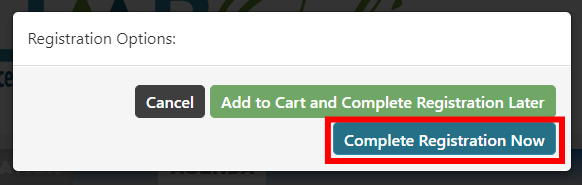
Follow the prompts to complete your registration.
If you are signed out, you will only see the word “Register” without a price in the green box of the upper right corner. Please login to your account at https://www.ahra.org/home. Once you are logged in, navigate back to this page and follow the instructions above.
How to access live CLIMB sessions:
In order to access CLIMB Online 2026 sessions, you must log in to your AHRA account in AHRA's Learning Management System (LMS), the Online Institute (https://onlineinstitute.ahra.o...). Once logged in, click “My Courses/Exams” under the “My Account” tab:
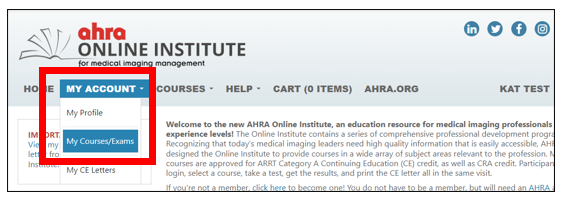
This will take you to your personal “Dashboard” in the Online Institute. You will see the “CLIMB Online 2026 Virtual Conference” package listed at the top of this page:
After clicking on the CLIMB Online 2026 Virtual Conference, you can explore the different session offerings under the "Content" tab. If you see a session you want to attend live, you can click into that session to learn more.
To see when the session is scheduled to begin, click the "contents" tab. You will only be able to join live sessions about 5 minutes before they are scheduled to begin. Once the session is about to begin, click "Enter Live Event in Progress"
If the session is not scheduled to begin for a while, you have the option to save it to your personal calendar as well. Simply click “Add to Calendar” under the "Contents" tab. This will block the time off on your calendar as well as provide the direct link to access the webinar when it is time to start. Otherwise, you can access each live session from this page about 5 minutes before its designated start time:
How to access on-demand CLIMB sessions:
To access the CLIMB Online 2026 on-demand library of sessions, you must be logged in to your AHRA account in AHRA's Learning Management System (LMS), the Online Institute (https://onlineinstitute.ahra.o...). Once logged in, click “My Courses/Exams” under the “My Account” tab:
This will take you to your personal “Dashboard” in the Online Institute. You will see the “CLIMB 2026 On-Demand Library" package at the top of this page:
Click into the CLIMB Online 2026 On-Demand Library, and then click the "Content" tab to see the recorded sessions available to you. Then, just click into the session you would like to watch to get started:
FAQs
Who do I contact if I'm unable to log into my Online Institute account?
If you are having issues accessing the CLIMB Online 2026 and/or the Online Institute, please email [email protected].
How long will I have access to CLIMB 2026 session recordings/materials?
All CLIMB Online 2026 registrants will have access to session recordings and session materials until December 31, 2026.
How do I obtain CE credits?
For live sessions:
In order to obtain CE credits for sessions attended on Thursday, March 19, and Friday, March 20, you must access the respective webinar sessions via your Online Institute account — this is how our system logs your attendance. Please note you must access each live Zoom session for its entirety in order to earn the associated CE credit(s). Then, you MUST complete the associated session evaluation; if you do not complete the session evaluation, you will not receive CE credit for that session.
For on-demand sessions:
In order to obtain CE credits for any on-demand CLIMB sessions, you must view the entire recording. Then, you must complete the associated post-test for the session. You will have three attempts to complete the post-test with a score of 80% or higher. If you do not pass the post-test after three attempts, you are NOT eligible to receive CE credit for that on-demand session.
How long will it take for my CE credits to appear?
It will take 24 hours for your CE credits to appear in your Online Institute account.
-
Register
- Non-member - $299
- Member - $199
- More Information
-
Register
-
Contains 2 Component(s)
Radiology teams are navigating unprecedented complexity that include rising scan volumes, workforce shortages, financial pressure, and growing burnout, all while still being expected to deliver faster, more confident diagnoses. Artificial intelligence is emerging as a powerful enabler, yet adoption varies widely as imaging leaders assess where AI truly delivers value. In this exclusive webinar, Philips experts will share insights from the 2025 AHRA–Philips Survey, capturing perspectives from imaging leaders across health systems nationwide. While concerns remain, 79% of respondents express optimism about AI, viewing it as a tool that supports radiologists rather than replaces them.
Radiology teams are navigating unprecedented complexity that include rising scan volumes, workforce shortages, financial pressure, and growing burnout, all while still being expected to deliver faster, more confident diagnoses. Artificial intelligence is emerging as a powerful enabler, yet adoption varies widely as imaging leaders assess where AI truly delivers value.
In this exclusive webinar, Philips experts will share insights from the 2025 AHRA–Philips Survey, capturing perspectives from imaging leaders across health systems nationwide. While concerns remain, 79% of respondents express optimism about AI, viewing it as a tool that supports radiologists rather than replaces them.
Join us as we explore key findings from the survey and discuss how organizations can make AI a practical, trusted part of today’s imaging workflow by:
- Overcoming adoption barriers such as budget constraints, workflow integration challenges, and trust in AI-driven results.
- Reducing manual, time-intensive tasks to ease burnout and improve operational efficiency.
- Enhancing image quality with AI technologies that increase diagnostic confidence and enable more proactive, precision-driven care.
- Leveraging AI-powered opportunistic imaging to identify undiagnosed conditions and reduce the need for additional screenings.
You’ll also learn how Philips is supporting this journey with smart, connected, clinically meaningful AI innovations designed to improve speed, accuracy, and efficiency across imaging environments.
This program was sponsored by Philips.
Sonia Tripathi (Moderator)
Head of Marketing, Precision Diagnosis
Philips Healthcare
Sonia is a seasoned sales and marketing leader with 18+ years of experience in the imaging industry, spanning global strategy, portfolio leadership, and commercial execution. At Philips, she has played a key role in building the North America Imaging Marketing organization in close partnership with global teams and was recently appointed Head of Marketing for Precision Diagnosis, leading the function globally. Prior to Philips, Sonia held a brief role at a healthcare AI startup and spent most of her career at GE HealthCare, where she served as Global Chief Marketing Officer for Molecular Imaging and Computed Tomography, driving global launches and portfolio strategy. She is known for her collaborative leadership, strong execution, and passion for building high-performing teams and advancing innovation that benefits customers and patients.
Heather Chait, MBA, DPM
AI Clinical Ecosystem Lead
Philips Healthcare
Heather is a strategic healthcare physician and business executive with extensive experience across clinical practice and innovation. An entrepreneur with over a decade in medicine, she has worked with several early-stage, venture-backed companies, including Surgical Innovation Associates, acquired by Integra Life Sciences. She remains active in the startup community as a mentor. At Philips, Heather serves as the Clinical AI Ecosystem Lead, focusing on how strategic partners can accelerate the impact of AI in diagnostic imaging and clinical care across business units. Prior to Philips, she held leadership roles in AI partnerships and strategic alliances at GE Healthcare, Highmark Health, and TeraRecon. She holds an MBA from the University of Notre Dame, a BS in Biology and a DPM from Rosalind Franklin University, and completed her residency in Foot and Ankle Surgery.
Wilson To, PhD
Head of Strategy, EI
Philips Healthcare
Wilson To is a business executive focused on scaling healthcare with cloud and AI. At Royal Philips, he oversees global strategy across the company’s medtech informatics business, shaping initiatives that deliver a differentiated portfolio across integrated diagnostics and acute care. He also leads business development to accelerate mergers, acquisitions, divestments, and strategic technology partnerships. Previously, Wilson was the head of healthcare at Amazon Web Services, where he built industry cloud technologies and go-to-market programs that enabled thousands of organizations to advance digital, cloud, and AI transformation. He also led research and product teams within Amazon’s Grand Challenges group. Wilson holds a PhD in Integrative Pathobiology from UC Davis, where he published research on microcirculatory systems related to vascular disease. He remains active in academia as a Gates Foundation Fellow, National Advisory Board member for UC Davis Health, and Graduate Faculty Scholar at the University of Central Florida.
Jeffrey H. Miller, MD
Chief of Radiology
Phoenix Children’s Hospital
Jeffrey H. Miller, MD, is a pediatric neuroradiologist and chief of radiology at Phoenix Children’s. Drawn by the chance to help grow a leading health system, he remains inspired by its mission and impact. Influenced by compassionate doctors in his youth, he chose medicine to provide the same level of care. Dr. Miller earned his medical degree at Semmelweis University in Budapest, followed by training at St. Luke’s Hospital, St. Louis University School of Medicine, and a neuroradiology fellowship at the Mallinckrodt Institute of Radiology at Washington University. He is active in research, widely published, and a member of major radiology societies. He values the trust families place in him, noting Phoenix Children’s unique ability to deliver complex care in the Southwest. Outside work, he enjoys family time, fitness, running, and cheering on Seattle sports.
Nickki Hardin, MHA
Healthcare Director
Huron Consulting
Nickki Hardin is a seasoned healthcare leader with over 30 years of experience spanning clinical radiology, hospital operations, consulting, and healthcare IT. With a Master’s in Healthcare Administration and certifications in radiologic technology, mammography and imaging informatics, she has led large teams, driven multimillion-dollar improvement initiatives, and supported strategic growth in both pediatric and acute care environments.
Her expertise includes imaging department leadership, healthcare consulting, IT implementation, Medicaid and payor strategy, performance improvement, equipment procurement and sales enablement. Nickki has worked with top organizations like Optum, Huron Consulting, and Children’s Hospital & Medical Center Omaha, delivering measurable results through innovative leadership and cross-functional collaboration.
-
Register
- Non-member - Free!
- Member - Free!
- More Information
-
Contains 3 Component(s), Includes Credits
AHRA February 2026 Quick Credit - The credit earned from the Quick Credit (TM) test accompanying this article may be applied to the AHRA Operations Management (OM) and Human Resource Management (HR) domains.
By Kernesha Weatherly
In today’s world, immediacy is everything. From on-demand entertainment to same-day shipping, society as we know it, has now conditioned itself to expect instant gratification. Gone are the times when you had to wait your turn to use the family landline, hoping the neighbor or your sibling would finally hang up so you could make a call.
Remember sitting by the radio, cassette tape ready, waiting for your favorite song to play so you could record it, only for the DJ to talk over the intro? Or rushing to the mailbox to see if your pen pal, a faraway friend, or even a love interest had written you back? Before email and text messages, communication wasn’t instant; it was an exercise in patience.
These moments, once a natural part of daily life, have all but disappeared, replaced by a culture of now. While convenience has its perks, there was something uniquely satisfying about the anticipation of waiting. Something today’s instant world may never quite understand.
This mentality has seeped into healthcare, where the word STAT has become less about true urgency and more about an expectation of immediacy, regardless of medical necessity. Nowhere is this more apparent than in the field of Imaging, where an overabundance of STAT imaging orders is stretching departments to their limits. But was this really the intended goal?
-
Register
- Non-member - $20
- Member - Free!
- More Information
-
Register
-
Contains 3 Component(s), Includes Credits
AHRA February 2026 Quick Credit - The credit earned from the Quick Credit (TM) test accompanying this article may be applied to the AHRA Operations Management (OM) and Human Resource Management (HR) domains.
By Jennifer A. Kirkman MHA, RT(R)(VI), CRA, FAHRA
Outpatient satisfaction scores for fluoroscopy were the lowest in the department. One of the biggest opportunities was "Staff explained things." Knowing that both the teammates and the APPs explain the procedure, we asked the team in weekly huddle what they thought. No one had any ideas on how they could explain things differently. However, a teammate shared her frustration about a different issue and offered a possible solution. This one suggestion dropped our no-show rate by 30% in the first two months and allowed the department to not miss out on potential revenue for the scheduled patients.
Then the outpatient survey results started to climb. The teammate shared that many patients did not understand what they were scheduled for and appreciated having the opportunity to ask questions before arriving.
Patients now show up on time, and our outpatient survey results continue to climb. We now know ahead of time if patients tell us they are not coming for the appointment, allowing better facilitation of the inpatient orders into the daily schedule. Teammate engagement has increased, and they are not afraid to offer solutions when they escalate concerns.
Healthcare administrators face the unique challenge of improving employee engagement and patient satisfaction, two factors that are deeply intertwined. In a tight labor market with more open jobs than potential employees, retaining great talent has never been more important. Furthermore, studies show that engaged employees are more productive and more likely to remain with an organization.
Engaged employees also tend to deliver better care, which translates into stronger patient satisfaction scores. These satisfaction scores directly affect hospital reimbursement through CMS’s HCAHPS program. And as patients become increasingly savvy, sharing their experiences online, the connection between employee and patient satisfaction becomes even more acute. Departments that invest in employee engagement, such as through shared governance models, have demonstrated measurable improvements in staff engagement and patient experience.-
Register
- Non-member - $20
- Member - Free!
- More Information
-
Register
Latest AHRA News